
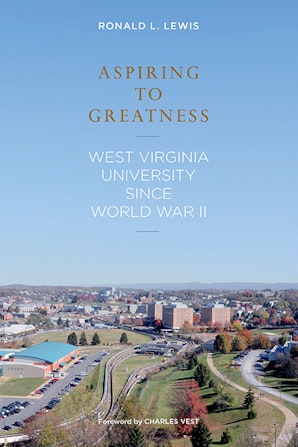

Aspiring to Greatness
West Virginia University Since World War II
Aspiring to Greatness: West Virginia University since World War II chronicles the emergence of WVU as a major land-grant institution. As a continuation of the work of Doherty and Summers in West Virginia University: Symbol of Unity in a Sectionalized State, this book focuses on the modern historical developments that elevated WVU from a small regional institution to one of national prominence. West Virginia University’s growth mirrors the developmental eras that have shaped American higher education since World War II. The University’s history as an innovative, pioneering force within higher education is explored through its major postwar stages of expansion, diversification, and commercialization. Institutions of higher education nationwide experienced a dramatic increase in enrollments between 1945 and 1975 as millions of returning World War II and Korean War veterans took advantage of the GI Bill of Rights. Their children, the “baby boom” generation, continued to supply the growth in college enrollment and the corresponding increase in institutional complexity until the mid-1970s. During this period WVU followed the national trend by growing from a few thousand students to nearly fifteen thousand. From 1975 to the early 1990s, expansion gave way to diversification. The traditional student population stopped growing by 1975, and “boomers” were replaced by students from nontraditional backgrounds. An unprecedented gender, racial, and ethnic diversification took place on college campuses, a trend encouraged by federal civil rights legislation. To a lesser degree WVU was no exception, although its location in a rural state with a small minority population forced the University to work harder to attract minorities than institutions in proximity to urban areas. The commercialization of higher education became a full-fledged movement by the 1990s. Major changes, such as globalization, demographic shifts, a weak economy, and the triumph of the “market society,” all accelerated the penetration of business values and practices into university life. Like other public universities, WVU was called upon to generate more of its own revenues. The University’s strategic responses to these pressures reconstructed the state’s leading land grant into the large complex institution of today. As the only modern history of West Virginia University, this text reaches into the archives of the President’s Office and makes exhaustive use of press accounts and interviews with key individuals to produce a detailed resource for alumni, friends, and supporters of WVU, as well as administrators and specialists in higher education.
PrefacePart I The Emergent University: Expansion, 1946–1967 Chapter 1. The Past as Prelude: Politics of Governance before the Board of RegentsChapter 2. Irvin Stewart and the Creation of a University “Both in Theory and Fact”Chapter 3. Paul A. Miller and “The People’s University,” 1962–1967Chapter 4. Student Affairs: The “Silent Generation” Part II The Constrained University: Diversification, 1967–1995 Chapter 5. Politics of Governance under the Board of RegentsChapter 6. The Administrations of James G. Harlow and Gene A. BudigChapter 7. The University at Its NadirChapter 8. Neil S. Bucklew, Modernization and ReformChapter 9. Faculty, Research, and Economic DevelopmentChapter 10. In Pursuit of Fairness and DiversityChapter 11. Student Culture Takes a Left TurnChapter 12. The Game Changes: Intercollegiate Athletics Part III The Corporate University: Commercialization, 1990– Chapter 13. Politics of Governance since the Board of RegentsChapter 14. David C. Hardesty Jr., Self-Governance RestoredChapter 15. The University as a Research EnterpriseChapter16. The Robert C. Byrd Health Sciences Center
Chapter 17. Becoming a Student-Centered UniversityChapter18. Intercollegiate Sports and the MarketplaceChapter 19. Playing on the National Stage: Corporatism and Intercollegiate AthleticsAfterwordNotesIndex (to come–freelance)About the Authors