
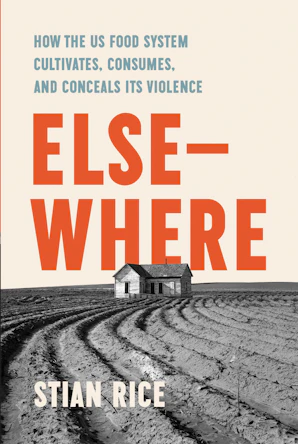

Elsewhere
How the US Food System Cultivates, Consumes, and Conceals Its Violence
Elsewhere argues that you can make all of the “smart” food choices you want and follow Michael Pollan to the letter, but that won’t end the violence in the food system. Eating is an act of violence. With every life-sustaining meal and food purchase, we shorten the lives of farmers, laborers, animals, the planet, and ourselves. This isn’t a symptom of a broken food system, but a feature of a working one: our capitalist food system doesn’t cause harm accidentally, it does so because it has to. To keep generating wealth, the system moves its violence around, away from privileged producers and consumers and into forgettable elsewheres: reservations, prisons, distant islands, killing floors, inner cities, rural hinterlands, and war-torn countries.
This shell-game is not new. Elsewhere examines the 250-year history of the US food system to uncover how the country used abundance to enrich some and exploit others; how it captured, colonized, and reorganized territory to conceal its harms; and why decades of technological innovation, environmental awareness, and consumer consciousness haven’t staunched these self-inflicted wounds. Elsewhere invites us to ask different questions about the food system: where does its violence come from, where does it go, and how can we nurture a food system that first does no harm.
List of Figures
Preface
Introduction: “The Food System Is Broken”
1 Divide and Cultivate: Removals, Reservations, and the Making of Elsewhere
2 Scatological Imperialism: Squandering Soil and Grabbing Guano for Ravenous Monocultures
3 Grand Theft Agriculture: Japanese American Incarceration and California’s Produce Empire
4 Grain, Grain Everywhere: Technology, Policy, and the Making of Excess
5 Invade, Aid, Trade: Making the World Safe for Profit
6 Of Meat and Migrants: Domesticating Humans and Animals Through Economies of Scale
7 Hunger Is Not a Polygon: Making Place for Malnutrition on the National Map
Conclusion: If It Ain’t Broke, Break It
Acknowledgments
Notes
Bibliography
Index
“Stian Rice offers a richly detailed examination of the American food system’s propensity to violence in accumulating massive surpluses, profits, and power. Elsewhere tells the stories of those people and places that have borne the brunt of appropriation and oppression in resolving capitalist agriculture’s contradictions and provided the land and labor that kept the US food system growing.”
—Jamey Essex, author of Development, Security, and Aid: Geopolitics and Geoeconomics at the U.S. Agency for International Development
“Rice has written an accessible accounting of the US food system and drives home the point that this industry exists to not create food, but profit, and in doing so, has forced “elsewheres” around the world to bear the brunt of the violence this system creates.”
—Ethan Bottone, assistant professor of geography at Northwest Missouri State University